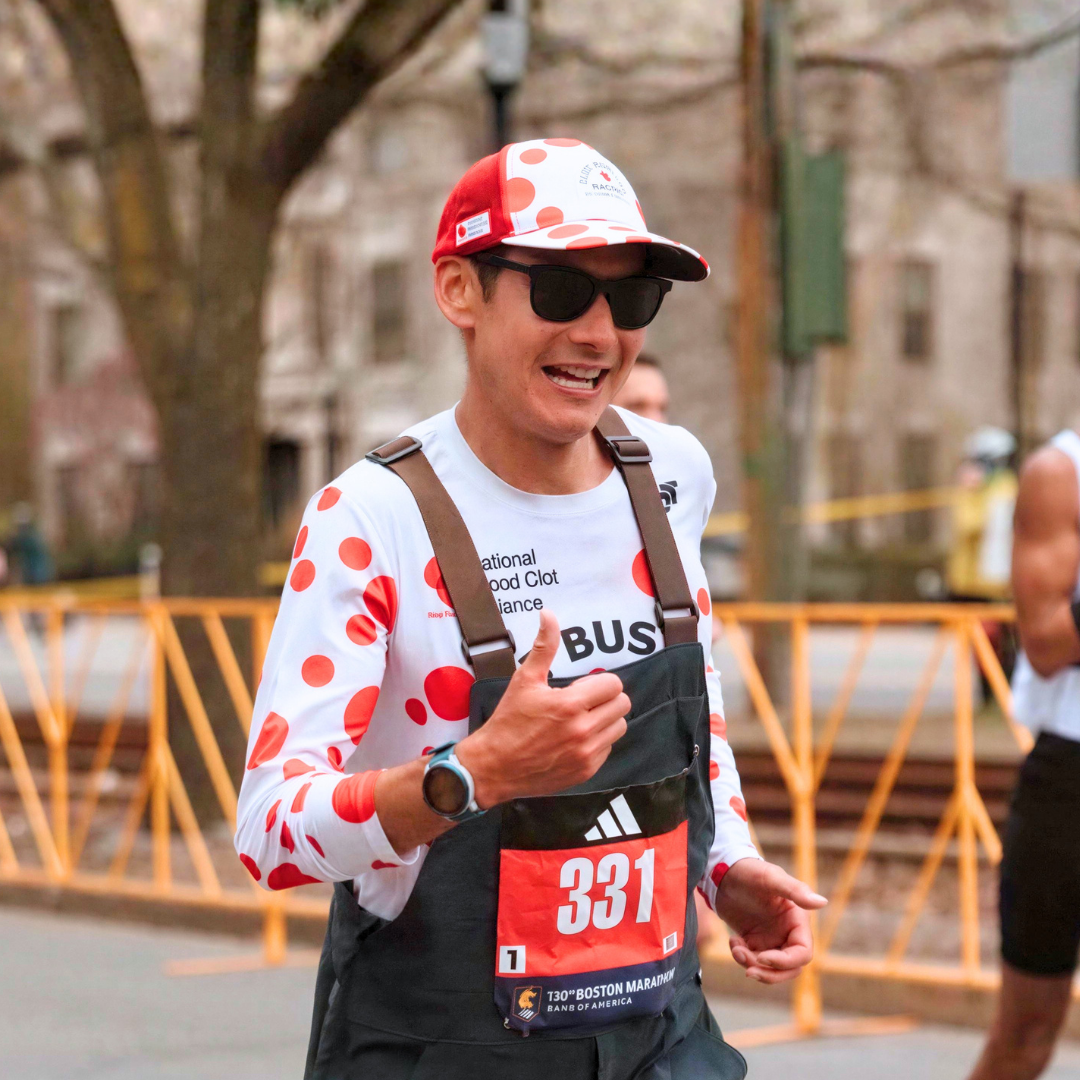
It was the spring of 2021. I was running like I usually do, training pretty much every day. I run quite a bit for my profession and to train for marathons and ultra distance marathon trail races, mainly, but also road marathons.
It was April and I had some slight back pain — actually that was the first symptom I noticed. Lower back. I didn’t know if it was around my kidneys. I’m not a medical expert so I just kind of wrote it off as back pain spasms that sometimes you get if you wake up on the wrong side of the bed or you don’t sleep right, or maybe it was from running. Sometimes if you do a hard hill workout or you run too far too fast you get some aches and pains, so I kind of shook it off as just being normal back pain — although usually my lower back doesn’t hurt like that. 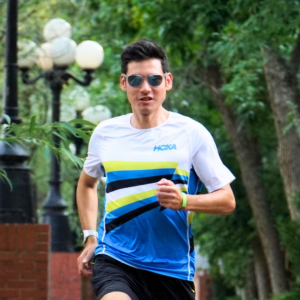
But I had back pain for a couple days and then what I really noticed was that my breathing was a bit labored all of a sudden. I have asthma and allergies and I’ve had mild breathing issues, but this was pretty severe. I was really struggling to catch my breath for a couple days and then the pain in my back kind of wrapped around my rib cage and it got a bit sharper. It got so bad that after about 3 days of this I had trouble lying down to sleep at night. It felt like a back spasm but it had wrapped around my rib cage — it started on one side and then went over to the other, right lung to left lung kind of, but always with this back pain, this chest pain, difficulty breathing.
We lived in an apartment complex and I had to walk up three flights of stairs — there wasn’t an elevator — and I’d really struggle, especially if I was carrying groceries. I live in Colorado at altitude but I’m a fit athlete, I do distance running as a profession. So to get out of breath walking up a flight of stairs was quite alarming. But I just shook it off and didn’t go in right away. I was worried about paying an emergency room bill so I kind of hesitated. That was a tough lesson.
It was about 5 days when I first started showing these light-headed symptoms, trouble breathing, a lot of pain. I did a general consultation — they took my temperature, tested me for COVID, did an X-ray on my lungs. They determined from the X-ray that they thought I had pneumonia, so they put me on antibiotics for either 10 or 12 days. Then I had another X-ray but my symptoms didn’t go away. I think it was probably a misdiagnosis of pneumonia — they could see something was going on in my lungs that was wrong but just with the limited image quality of the X-ray they weren’t able to diagnose it yet as a pulmonary embolism, which I think it was. I was suffering for another several weeks after that and the antibiotics just didn’t kick in or do anything.
I don’t even know what a pulmonary embolism was — I think I’d learned about it in health class, but I didn’t think being as active as I am, being 35 at the time, that a blood clot was on my radar at all. I didn’t have any symptoms of leg pain or like a DVT. I hadn’t been on any long plane flights or had surgery or had a major bone break or injury. So the risk factors seemed really low.
They X-rayed my lungs again and thought it had cleared up, but it hadn’t. I absolutely could not run — I couldn’t even run on a flat sidewalk for a block. I’m a professional runner. I’d try to go out at my slow pace and after about 20 or 30 seconds I’d be breathing so hard and my heart rate would be so high I’d have to stop and just walk. Running is hard but it was exponentially harder. I even started coughing up blood around that time. I thought it was still pneumonia because that’s what they told me, but then I noticed I was actually coughing up blood which was quite scary.
It had been about four or five weeks since my initial back pain. I remember it very distinctly — I was going out for a run on a bike path near my apartment in Boulder and I absolutely couldn’t run for more than a minute at a time. A couple blocks from my apartment I felt this tremendous pressure on my chest and I was just thinking it feels like I’m going to have a heart attack, because there was just all this pain across my chest and my breathing was so labored.
That evening I was lying down in bed in a ton of pain and early the next morning I just woke up in the middle of the night and told my girlfriend she had to drive me to the emergency room. I knew I couldn’t make it through the day. It was a holiday weekend in May and the ER actually wasn’t crowded. I walked right up to the desk and they got me in really fast.
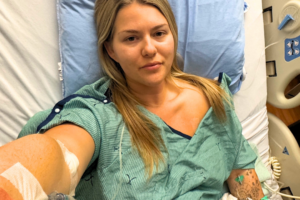
They did a blood test — one of the tests was a D-dimer. They did a complete blood cell count, hooked me up to an IV for saline, and a portable EKG. The real distinctive test that caught it and diagnosed it correctly was a CT scan with contrast — they used the IV port in my arm to inject this dye at the same time they took the pictures on the CT scan.
After those results came in — I didn’t know the results had come in yet — I was walking off to the bathroom in the hallway with my little IV port and I heard a nurse say “you need to stop him, we need to get him hooked up to the EKG right now because it’s serious.” They quickly came in and then told me that I had not only just a pulmonary embolism but a bilateral pulmonary embolism — it had gone into both lungs, both sides, and quite a few segments. They quickly injected a blood thinner right there on the spot and said it would kick in pretty fast.
They wanted to monitor me overnight. They taught me how to inject myself with a blood thinner and I had to take home a solution to give myself injections for about five days, then switched to an oral blood thinner pill that I would take for months after.
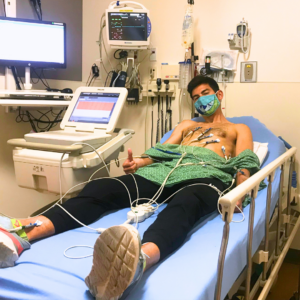
The pain started going away after several days and after a week or two my chest was getting lighter and it wasn’t so hard to breathe.
My PE is unprovoked and bilateral. They don’t know why I actually got a blood clot, and I think for me that was the hardest thing to process. I wanted an answer — why did this happen to me? I got a lot of testing done over the years since. I don’t have a family history. I didn’t travel on a long airplane flight. I didn’t even have evidence of a DVT.
Six years out, I’m still happy to be here. It kind of shifted my whole perspective — not only in running and coaching but in life in general. You kind of have some element of PTSD after something like this — I’ll wake up with a nightmare where I feel like there’s something heavy on my chest and I can’t breathe very well. But I’m still happy to be here.